VoiceOps: Webex Calling User Provisioning via GitOps
The Problem
Provisioning users in Webex Calling means clicking through Control Hub: create the person, assign the calling license, set the location, punch in an extension, pick the calling privileges. It’s fine for one user. It’s tedious and error-prone for a batch, and there’s no history — no diff, no review, no record of why someone’s extension changed six months ago.
I kept thinking: this is exactly the problem Kubernetes solved for infrastructure. Declare desired state, let a controller reconcile it. So I built VoiceOps — user lifecycle management for Webex Calling driven entirely by Git.
This is a public architecture overview of a private project. The manifests and engine live in a private repo; the write-up and the bot flow are documented at github.com/affragak/voiceops-overview.
The Idea: Users as Manifests
Every user is a YAML manifest, deliberately shaped like a Kubernetes CRD:
The Git repository is the source of truth. Want to onboard someone? Add a manifest. Off-board? Flip state: absent. The state of your telephony estate is now a reviewable, versioned, git blame-able set of files.
The GitOps Flow
A merge to main is the only thing that changes Webex. A GitHub Actions workflow runs the provisioning engine (provision.py) against only the manifests that changed:
Two things I care about here: a push only reconciles the user(s) that changed — never unrelated users — and a human merge gates every single change. Editing scripts, config or docs does not trigger a provisioning run.
The Provisioning Engine
provision.py is idempotent — users are looked up by email and updated in place, never duplicated:
| State | Action |
|---|---|
present |
Look up by email → create if new, update if existing → assign license + location + extension + privileges |
present (location changed) |
Detect the mismatch → run a Webex Move Users job |
absent |
Delete from Webex → move the manifest to manifests/archive/ |
The Move-Users Gotcha
This one cost me real debugging time. A person’s locationId is immutable on the Webex person object — you can’t relocate someone with a plain update. You have to drive the Webex Move Users job: validate → initiate → poll → done.
Except the job reported COMPLETED while the user never actually moved. The catch: a move reassigns the user’s identity-group membership, so the admin token needs the identity-group write scope on top of the telephony scopes. Without it the job “succeeds” but silently does nothing. Now the engine reads the job’s per-user errors endpoint and reports the real result instead of trusting the top-level status.
Lesson: with cloud APIs, a COMPLETED job status is not the same as the outcome you asked for. Verify the effect, not the acknowledgement.
A Webex Chat Bot Front-End
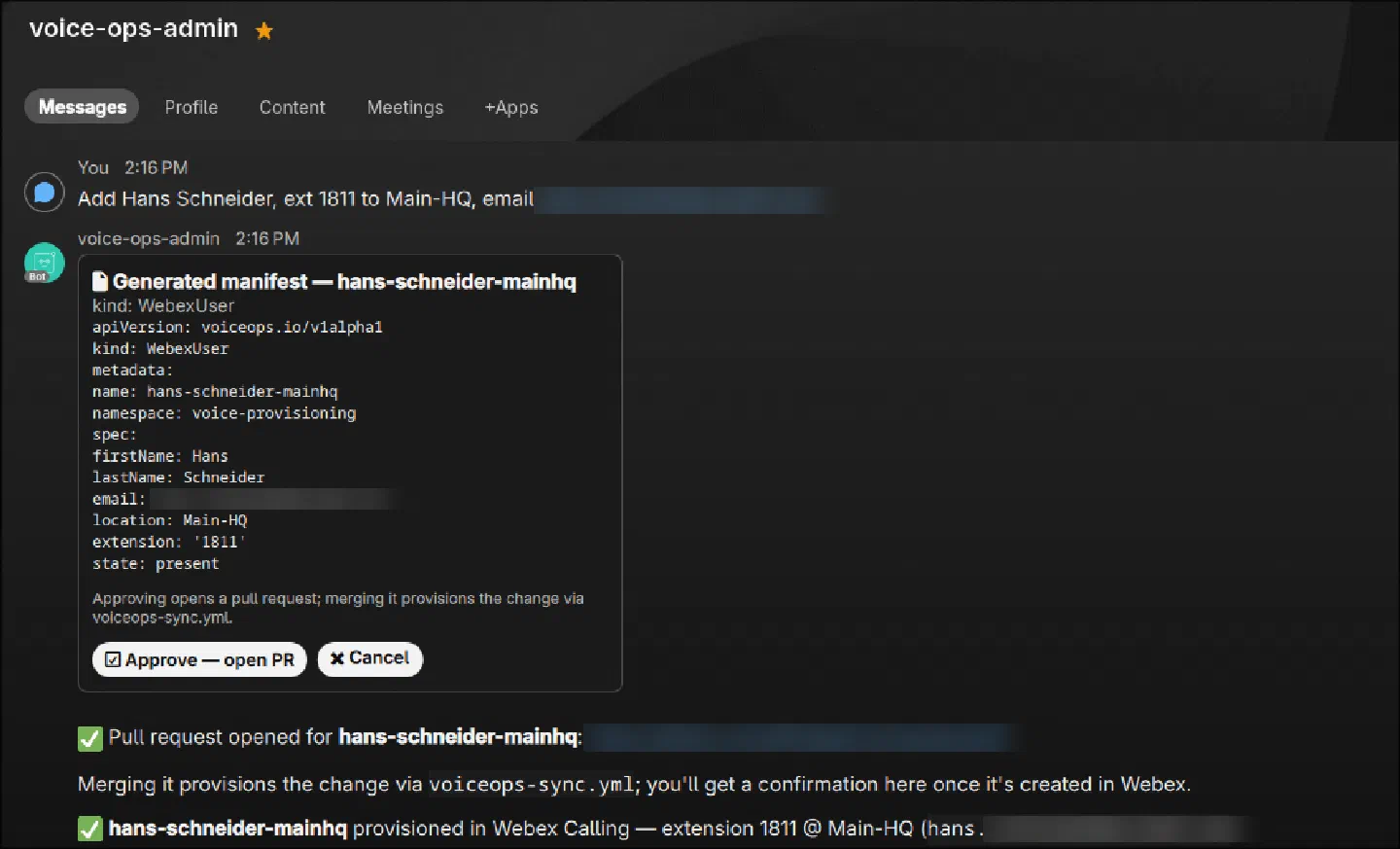
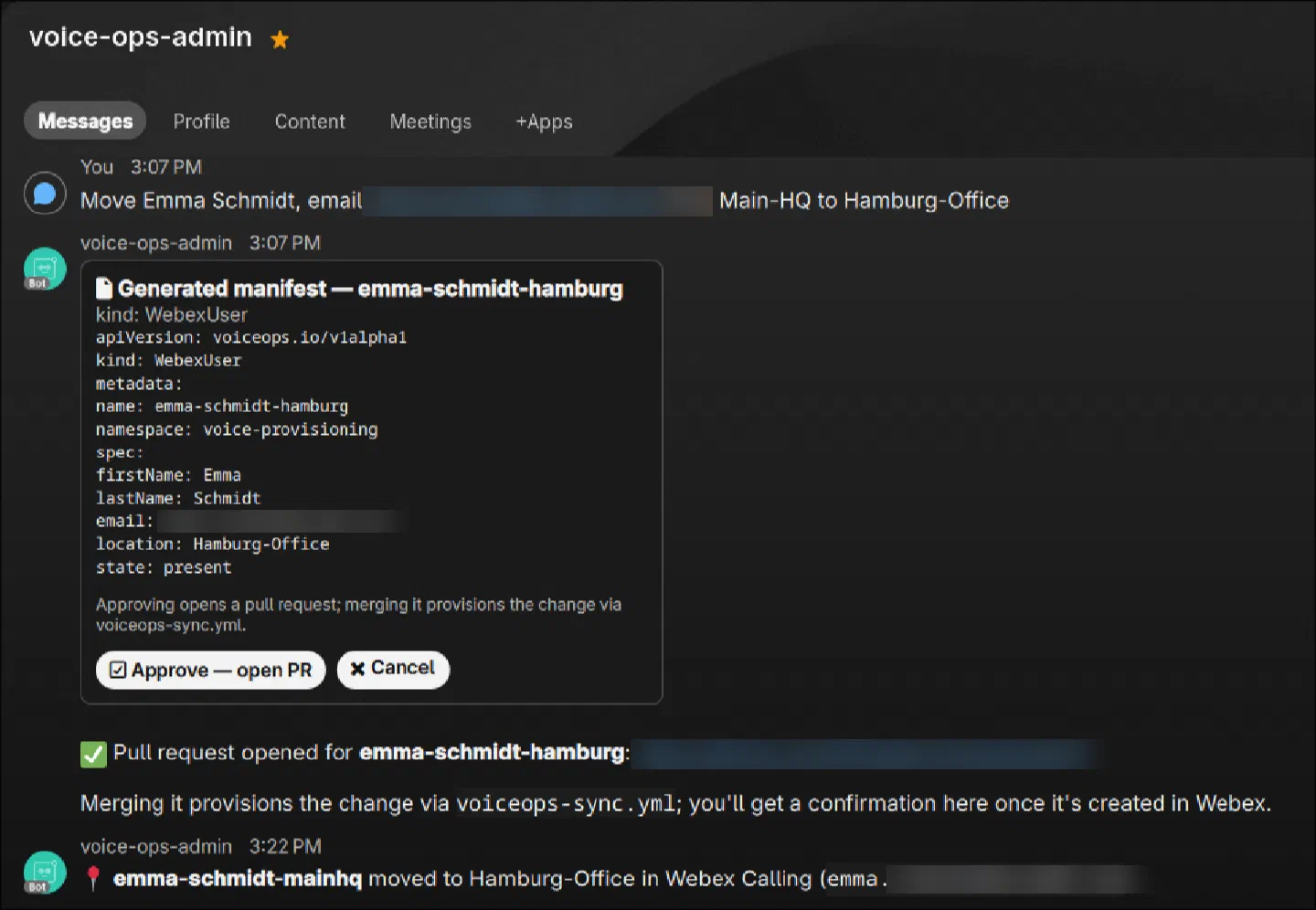
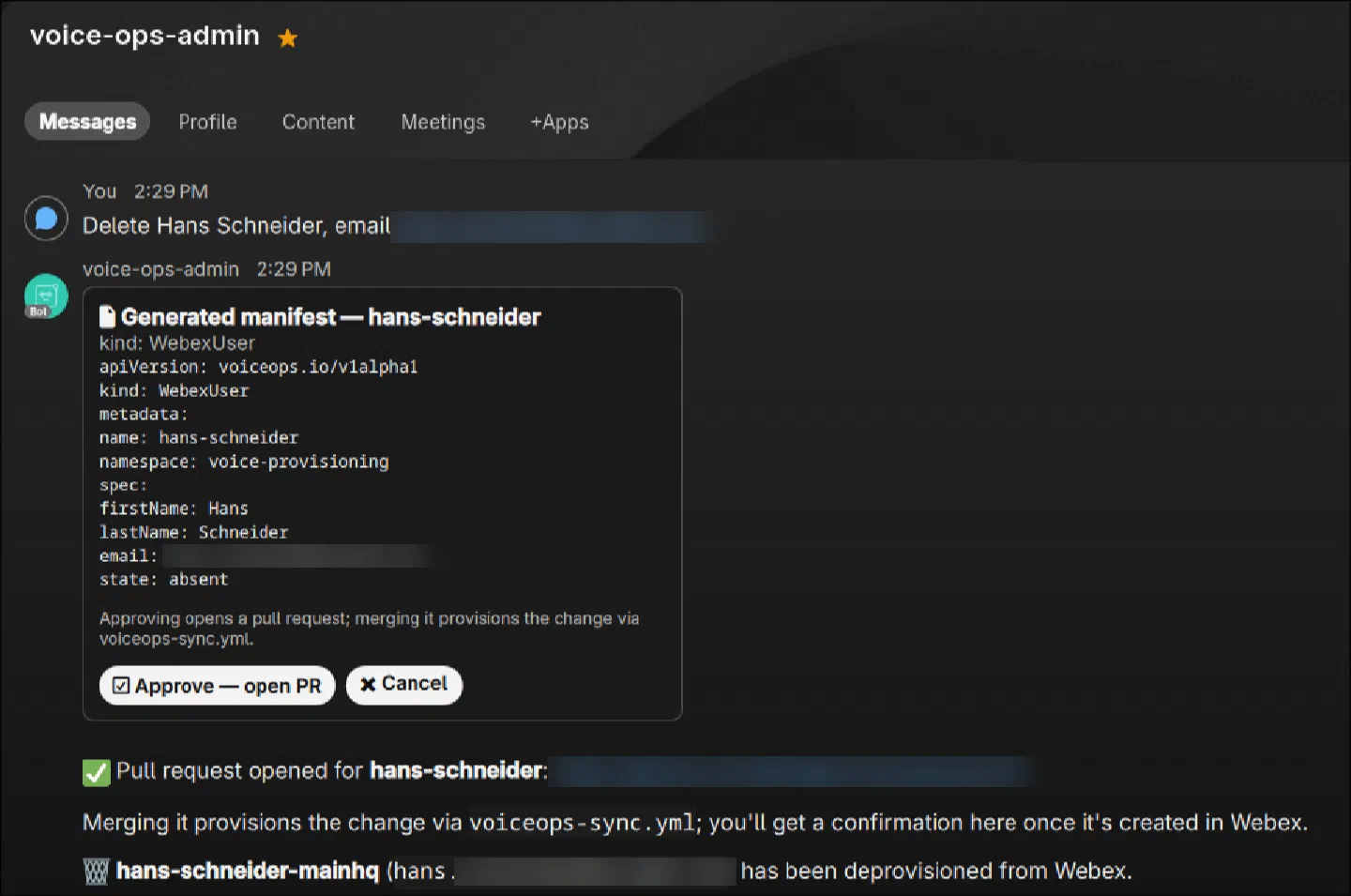
Editing YAML is great for me, but not for the average IT admin. So the same translation agent is wrapped as a native Webex bot. An admin DMs it in plain language; it generates the manifest, presents it on an Adaptive Card with Approve / Cancel, and on approval opens the pull request. The human merge still gates everything — the bot never touches the Webex admin API itself.
Each example below is a real DM: the request, the generated manifest on the card, the PR the bot opens, and the confirmation it posts once CI provisions the change.
Add a user
Move a user to another location
Delete a user
Drift Detection & Nightly Reconcile
Best-effort provisioning has a trade-off: a license or extension assignment can fail with a warning rather than blocking the batch, which means a user can be present in Git yet have no working dial tone in Webex. To catch that, provision.py --check compares a manifest against live Webex read-only and flags the mismatches a plain audit misses — including “calling declared but no Professional license assigned.” It exits 0 in sync and 2 on drift, so it doubles as a CI gate.
For continuous reconcile, the workflow also runs nightly (03:00 UTC) via reconcile.py, re-asserting every manifest — so a manual change made directly in Control Hub drifts back into line, ArgoCD/Flux-style. Each nightly run writes a dated Markdown report (reports/reconcile-YYYY-MM-DD.md) and commits it back, giving a versioned record of every reconcile. A workflow concurrency group serializes runs so overlapping merges can’t race on Webex writes.
Least-Privilege by Design
Credentials are split by concern so no single token can do everything:
| Purpose | Scope |
|---|---|
| Webex chat (bot) | Chat-only token, no admin scopes — can’t create or delete users |
| GitHub PRs | Fine-grained token, single repo (Contents + Pull requests) |
| Claude (agent) | API key, only on the bot host |
| Webex admin (CI) | people_read + people_write, stored as an Actions secret |
The bot that talks to humans holds no power to change Webex; the pipeline that changes Webex never talks to humans. The only bridge between them is a reviewed pull request.
Lessons Learned
- Treat telephony like infrastructure. Declarative YAML + Git review + a reconcile loop turns “who changed this extension?” from a mystery into a
git log. - Verify effects, not acknowledgements. A Webex job can report success while doing nothing — inspect the per-item result.
- Idempotency is what makes reconcile safe. Look users up by email and update in place; then re-running the whole set nightly is a feature, not a risk.
- Put the LLM at the edge, not in the control path. The agent only drafts a manifest; a human merge still provisions. Natural language lowers the barrier without handing the keys to a model.
- Separate credentials by blast radius. Chat token, PR token, admin token, LLM key — four keys, four concerns, no god-token.
Same GitOps muscle memory from the Hugo blog pipeline, pointed at Cisco Webex instead of a container image. Declare it, review it, let the robots reconcile it.